
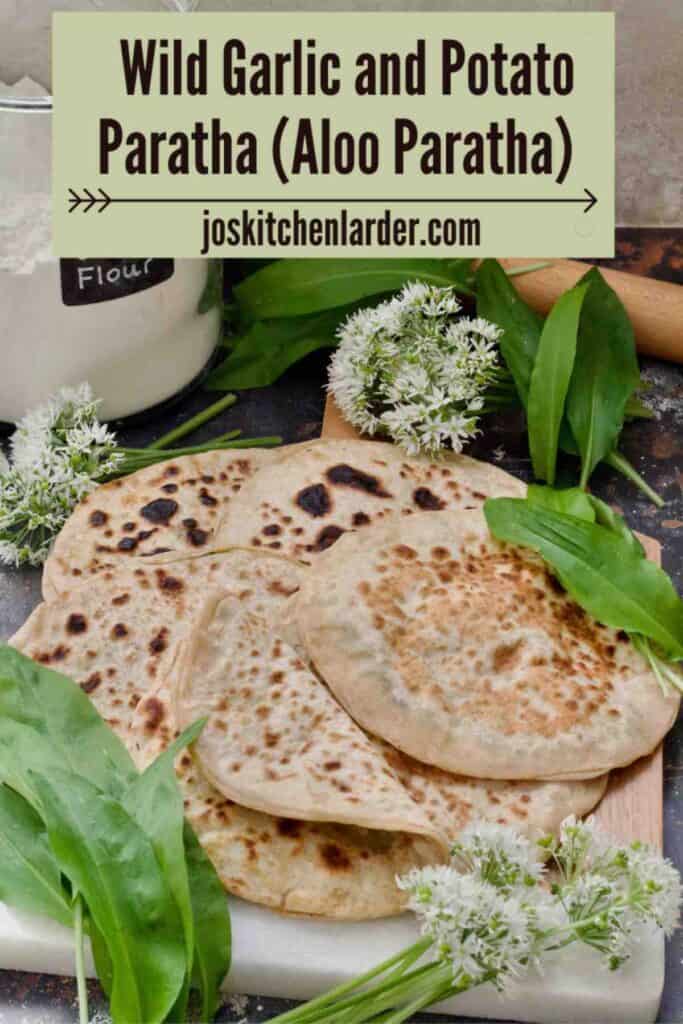
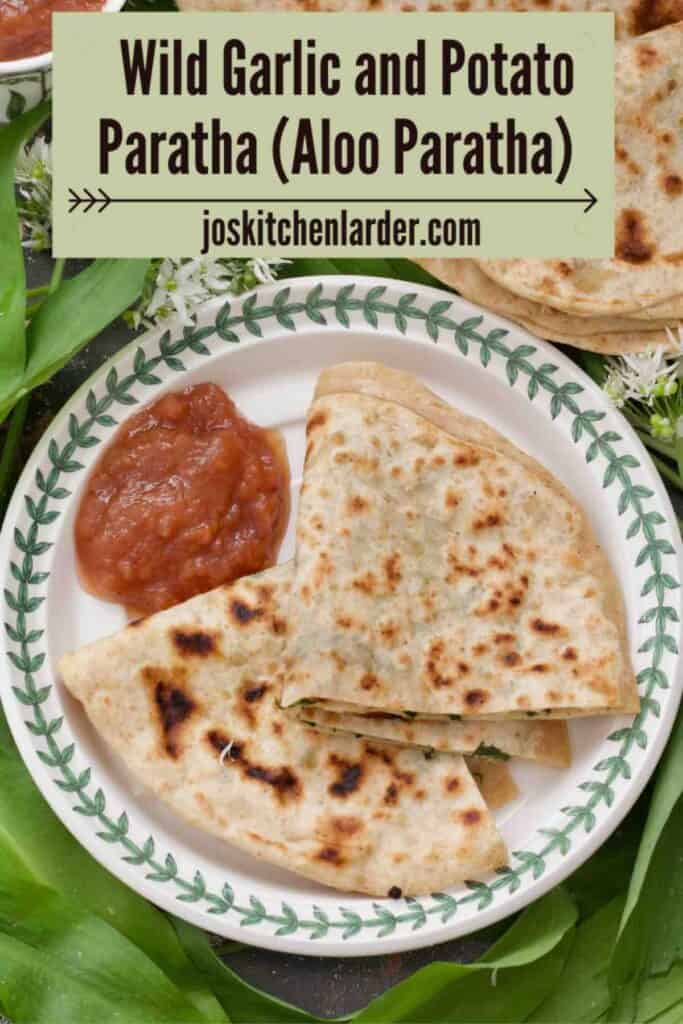
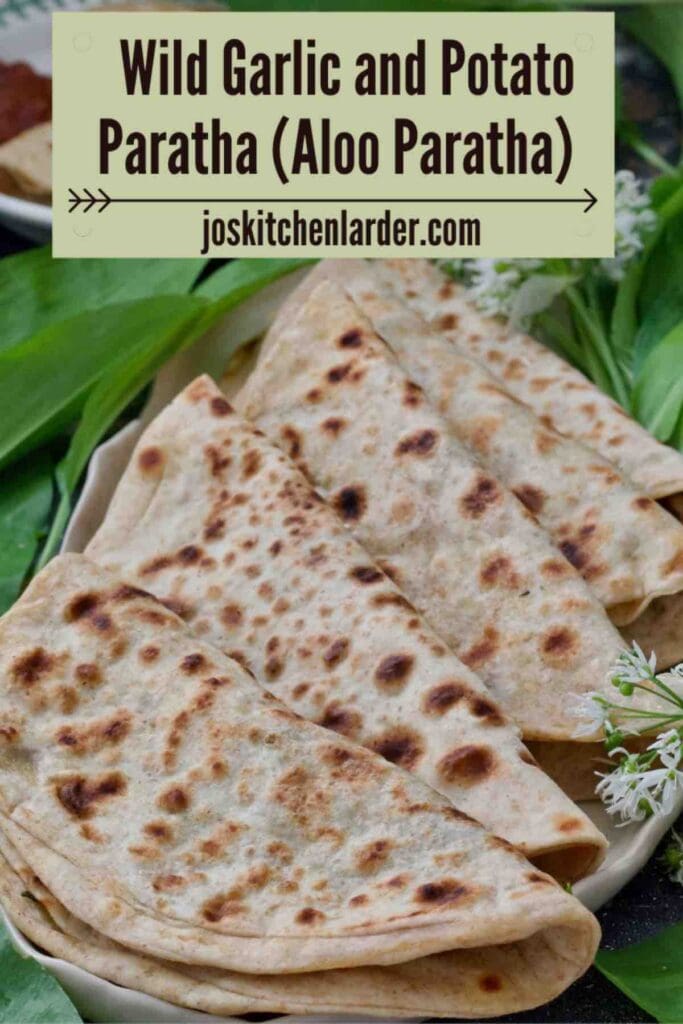
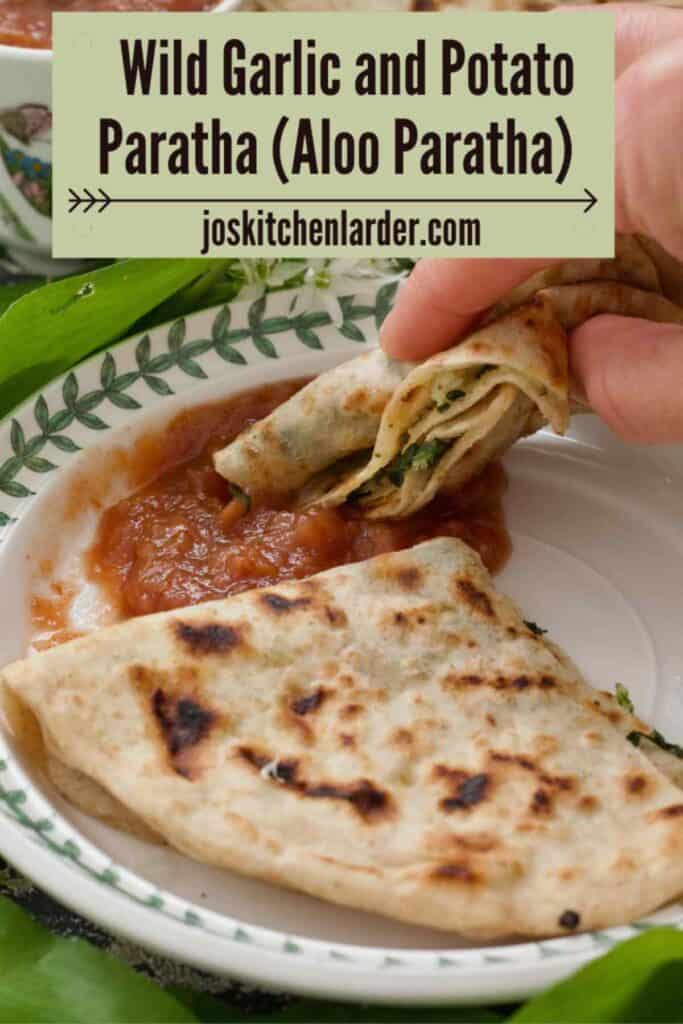
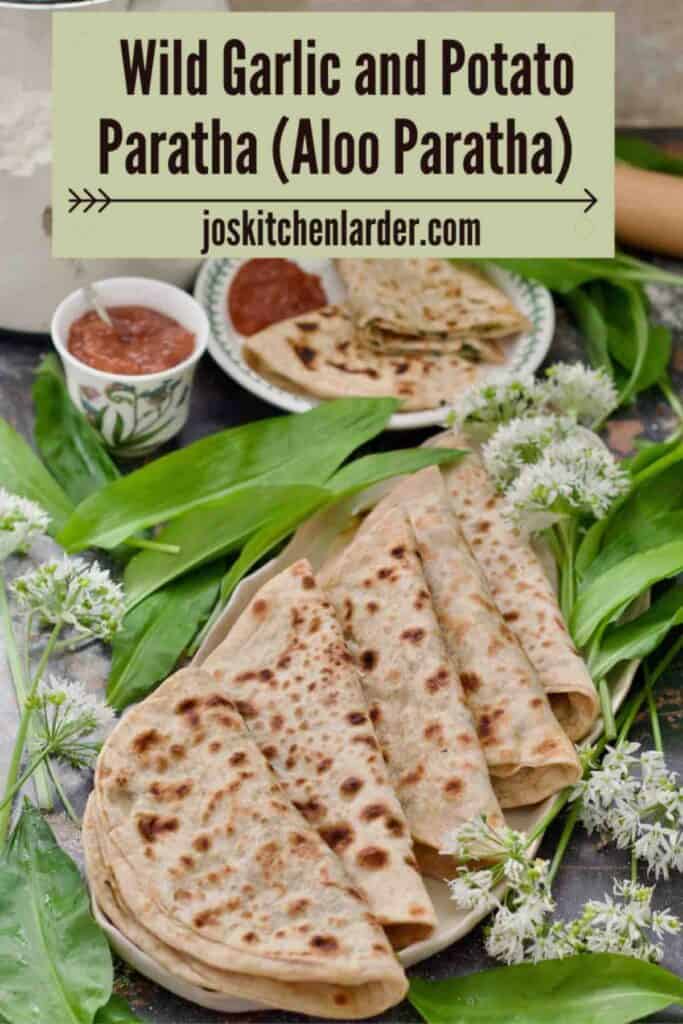
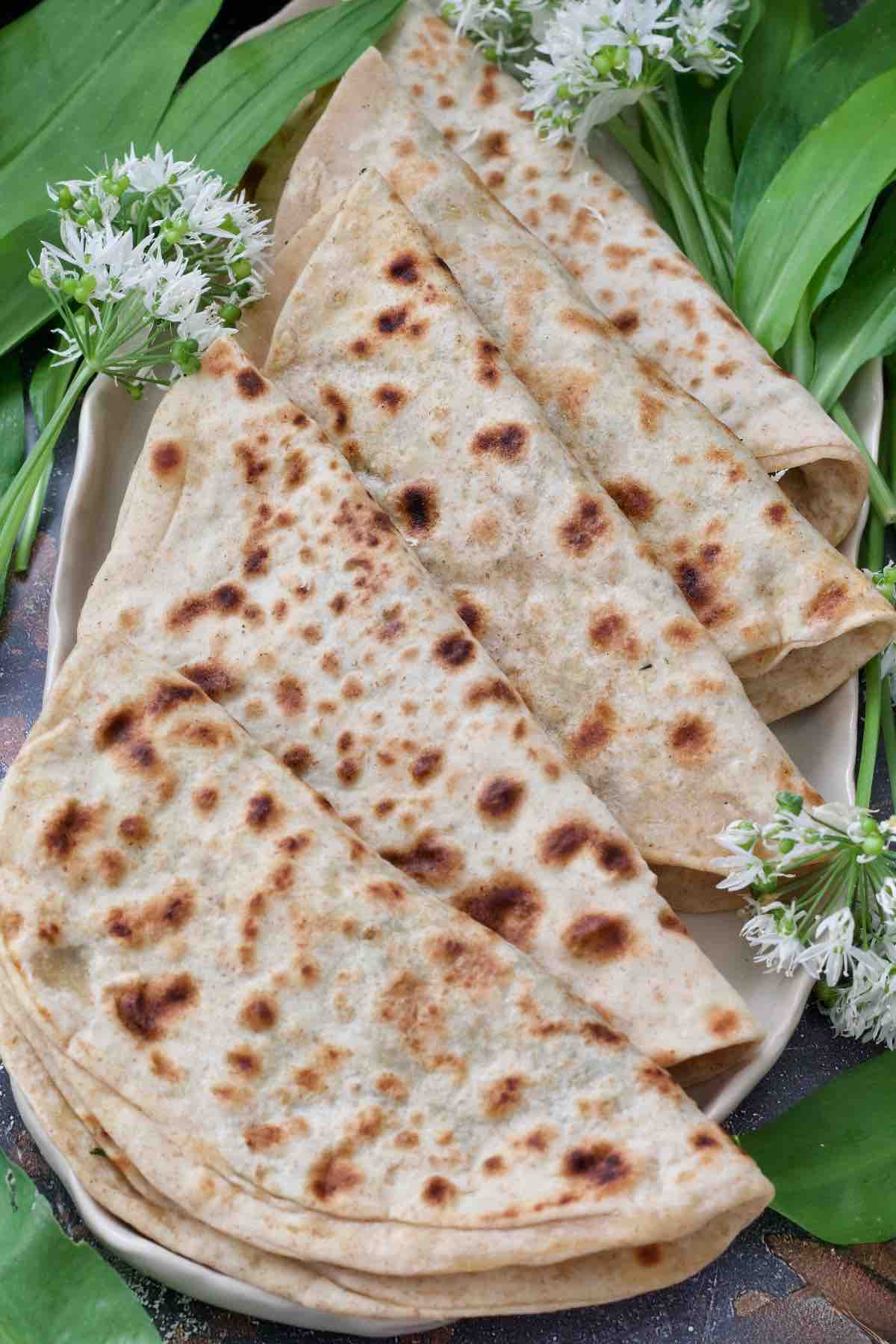
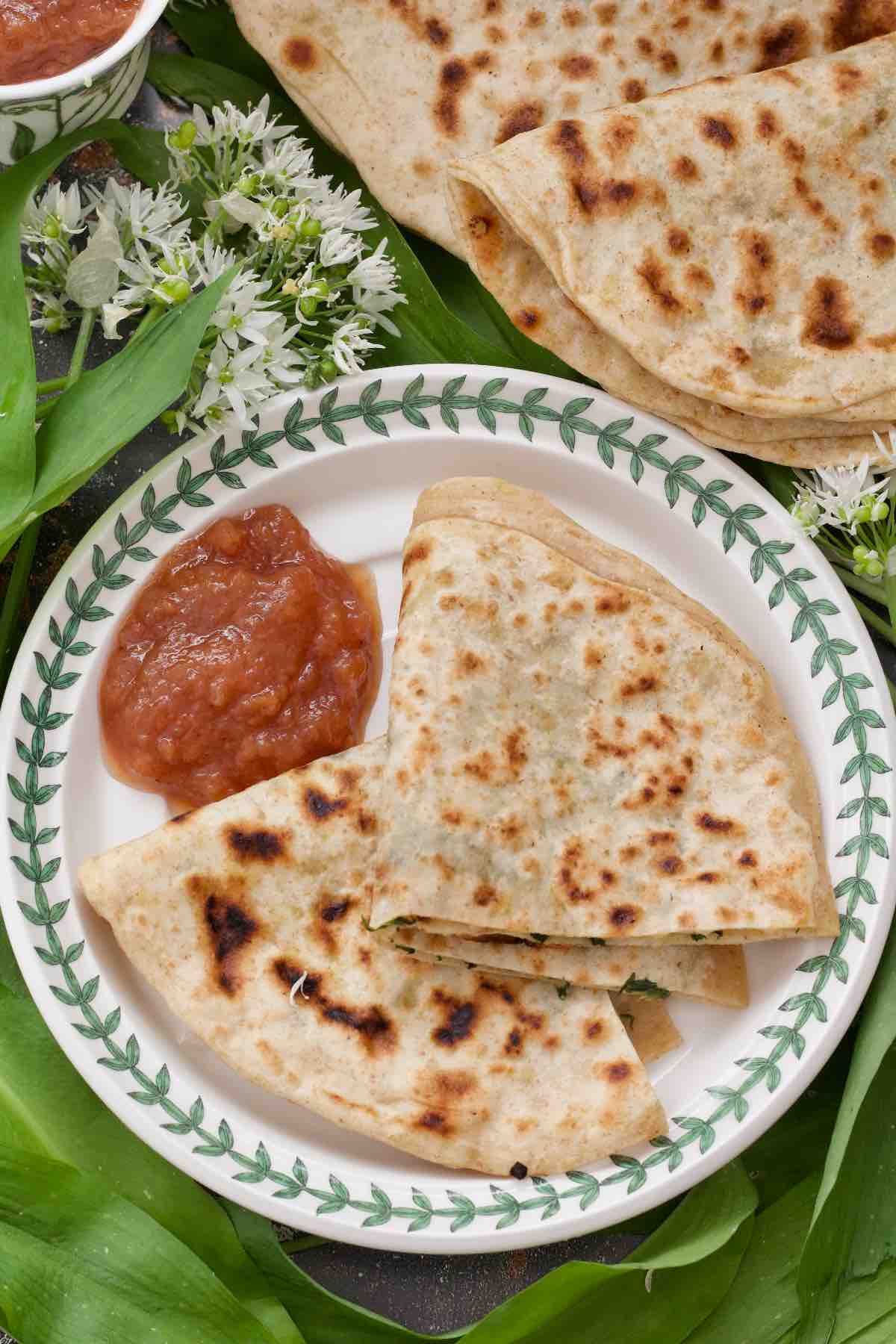
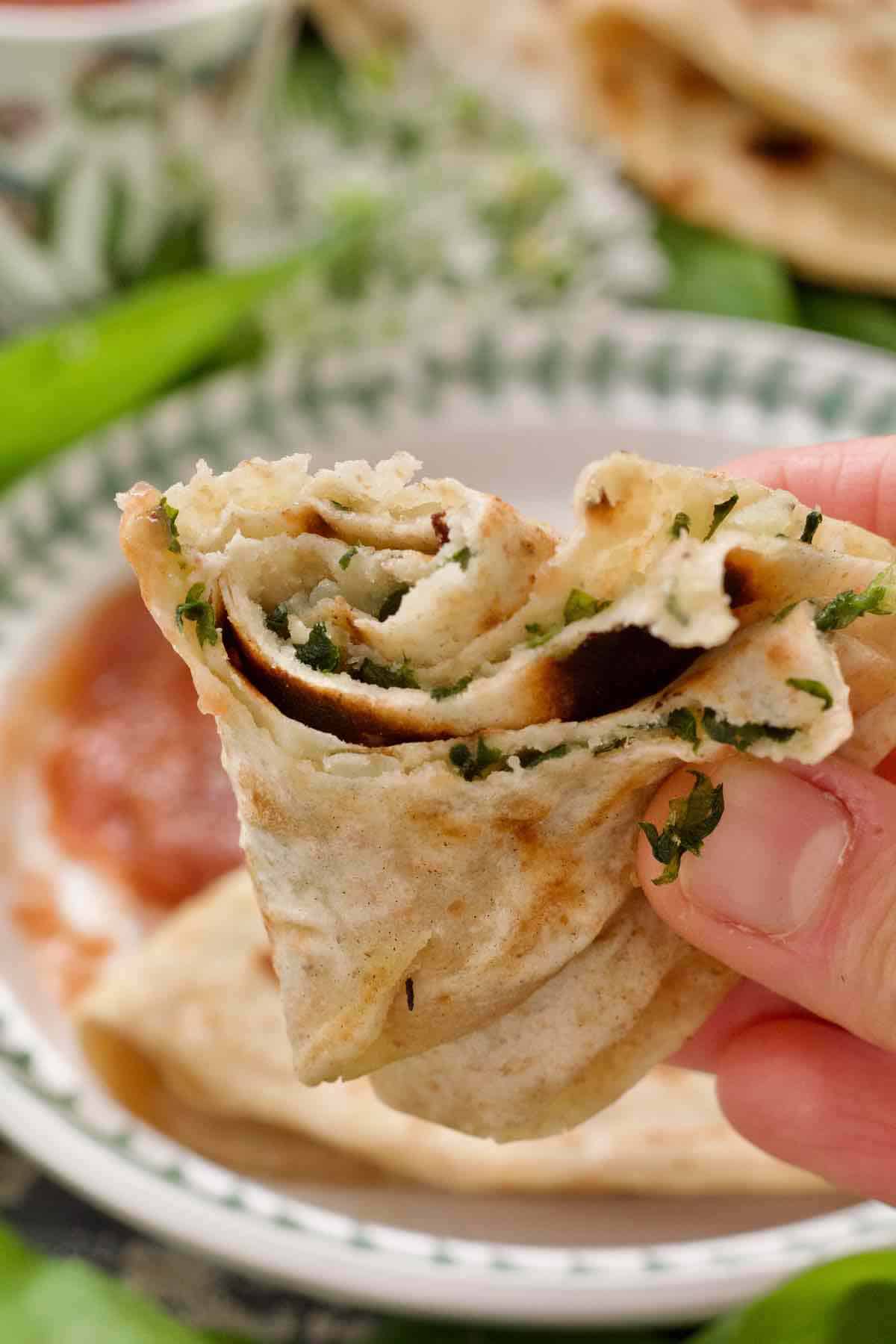
Wild garlic and potato paratha (aloo paratha) is my take on an Indian potato stuffed flatbread. I stuff mine very simply with a mixture of wild garlic, shallots and mashed potato. It's a flexible recipe that is easy to adapt as seasons change so it can be enjoyed all year round. So delicious!
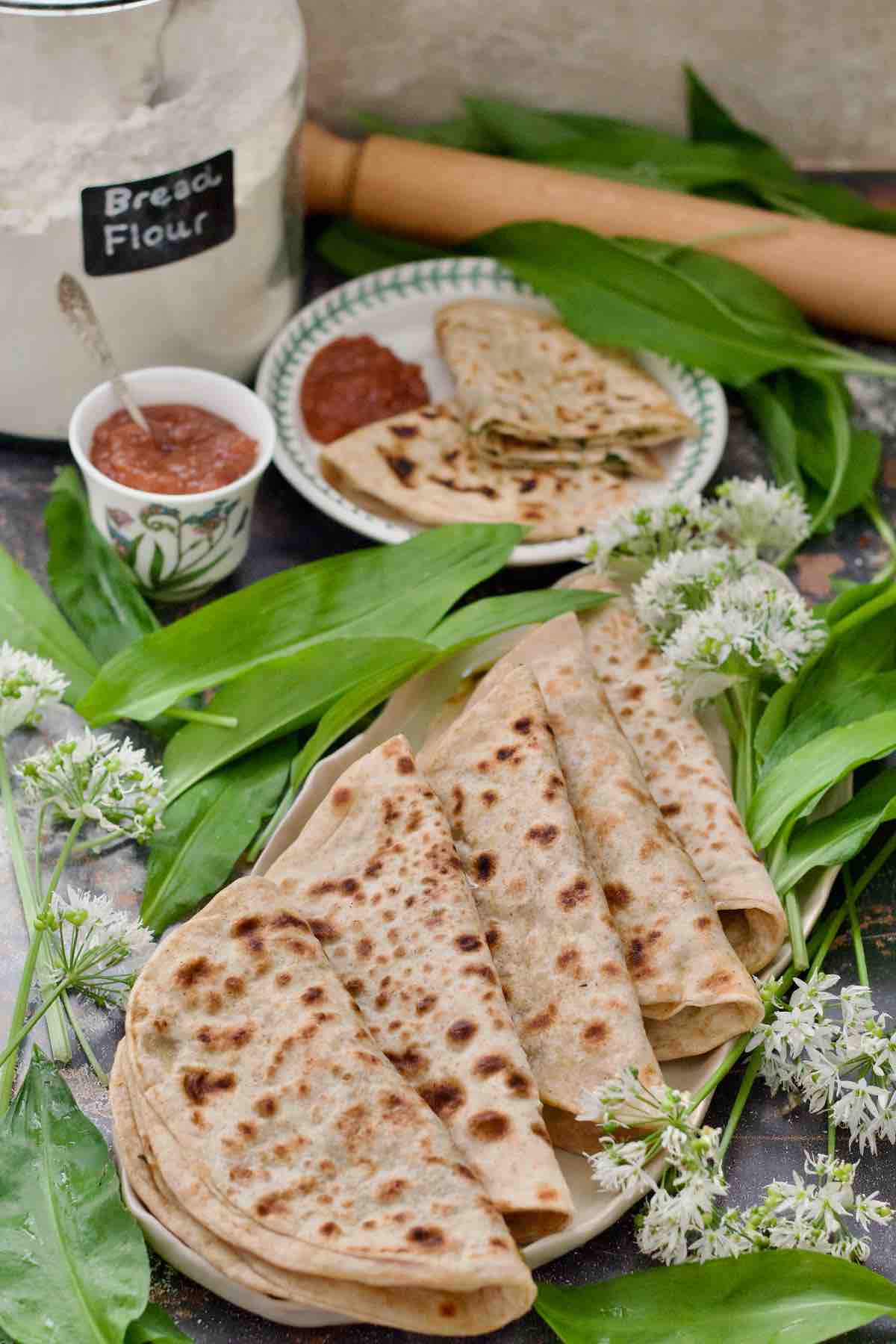
I should probably warn you that this recipe is far from authentic.
Indian aloo parathas (potato parathas) are usually filled with heavily spiced potato mixture that includes lovely Indian spices like garam masala, coriander, lots of chillies etc.
My aloo parathas on the other hand, don't include any of these whatsoever. Why? Because they celebrate wild garlic! Don't get me wrong, of course they're not bland. They're seasoned, if simply, with salt and pepper to suit your taste and to accompany wild garlic we also have some sautéed shallot for a tad of oniony sweetness. And of course fluffy mashed potato to carry both in their soft, comforting embrace. That's all and it's enough.
These wild garlic aloo parathas are beautifully simple and so so good!
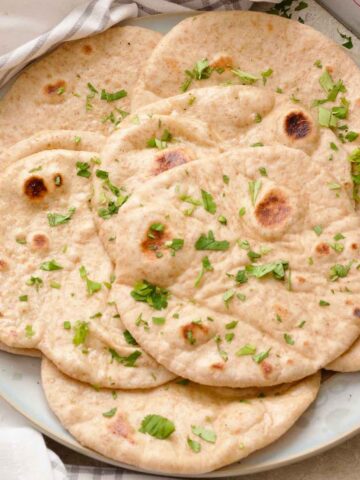
For more flatbreads check out my Easy Indian Chapati, No Yeast Naan Bread or super soft and pliable Easy Garlic Flatbread.
Jump to:
✔️ Why you'll love this recipe
- Super flexible recipe that can be adapted depending on your fancy, seasons, fridge content etc.
- Perfect way to use up leftover mash, waste free recipe.
- Great accompaniment to soups, stews and curries.
- Pretty impressive flatbreads which are actually really simple to make.
- Delicious wild garlic recipe.
- Naturally vegan.
- Reheat well, freezer friendly.
🛒 Ingredients to make Wild Garlic and Potato Paratha
Here's what you will need to make my Wild Garlic and Potato Paratha :
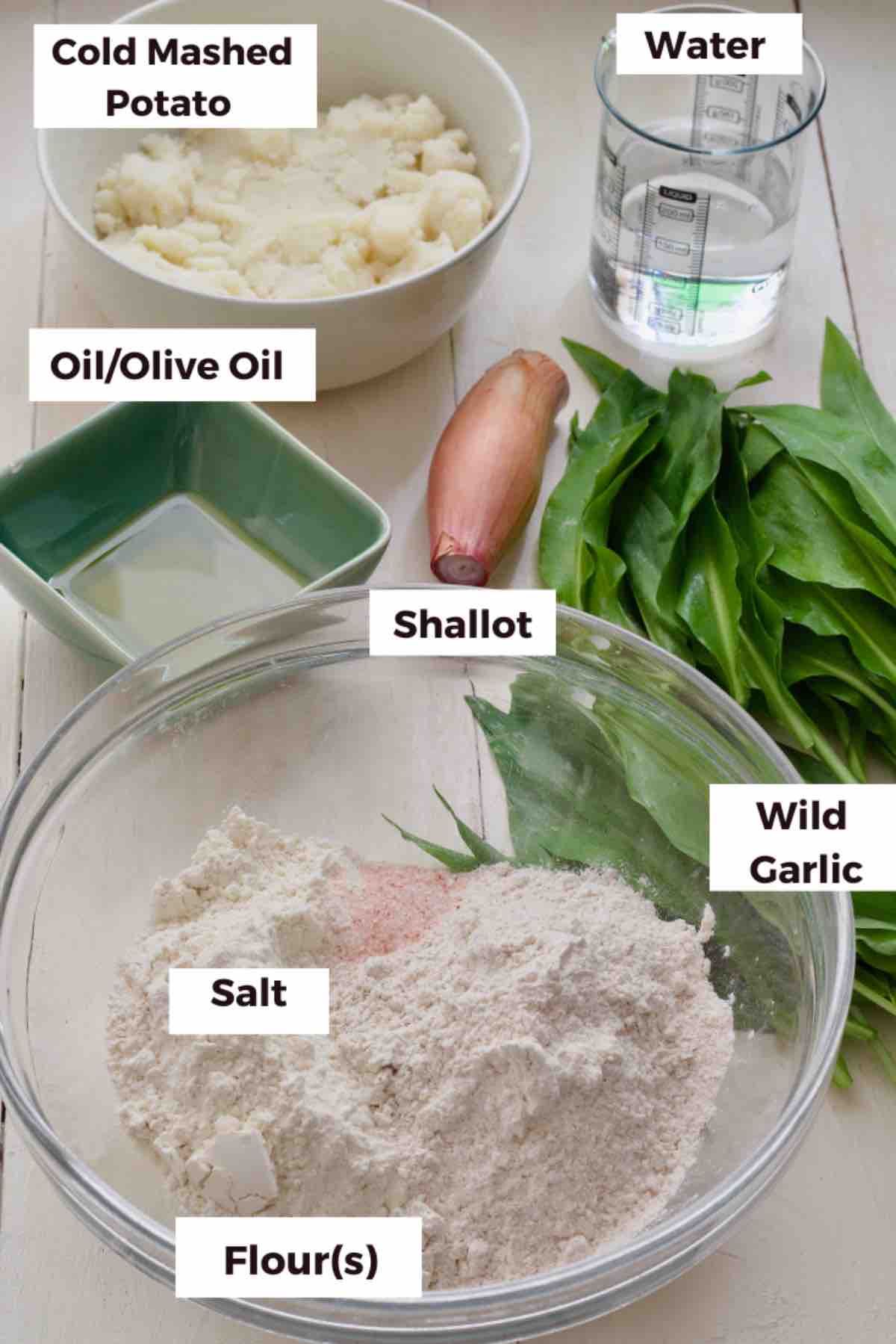
Flour(s) - For my aloo paratha I used half and half strong white bread flour and chapati (atta) flour which is a type of less course wholemeal flour. Authentic parathas are mostly made using atta flour just like chapatis but I decided on the mix of two for slightly lighter crumb.
Feel free to use 100% strong white bread flour (plain/all-purpose will be fine as well).
In the absence of atta flour you can use regular wholemeal flour as a substitute but unless you want tough parathas use some white flour as well (at least a third).
Water - Use slightly warm water (lukewarm) here as I find it allows the dough (once kneaded) to "relax" quicker and make it easier to roll out. Aim for temperature between 36.5-40.5°C (98-105°F). I use my handy probe thermometer to ensure the temperature is just right but you can simply gauge it with your finger. Water should feel just nice and warm to the touch.
Salt - Flavour. Use any fine salt you like.
Mashed potato - For my parathas I mostly use actual leftover mash but you can of course cook and mash some potatoes especially for this recipe. Just make sure it's not piping hot.
When using leftover mash, make sure it's not too creamy (we all have different preferences when making mashed potato). If you like your mash super creamy, you might be better off cooking and mashing some potatoes especially for this recipe without any or too much milk/butter etc.
Wild Garlic - Seasonal delight which if you can use here, please do. I use quite a substantial amount but it does mellow somewhat when mixed with potatoes. However, to be on the safe side and to ensure that you enjoy your parathas, you might want to start with less, mix it in, taste and add more if you want to. Make the filling work for you.
***Quick Tip***Take a look at FAQs below for suggestions on what to substitute wild garlic with when out of season.
Shallot/Onion - For that little bit of oniony sweetness.
Oil/Olive Oil - For brushing on parathas. You could use butter/ghee/plant butter as well. I tend to use my favourite workhorse oil in the kitchen cold-pressed rapeseed oil but you could use light olive oil as well if you prefer, just not extra virgin olive oil.
***Quick Tip*** To double up on wild garlic flavour you might want to brush your parathas with melted wild garlic butter.
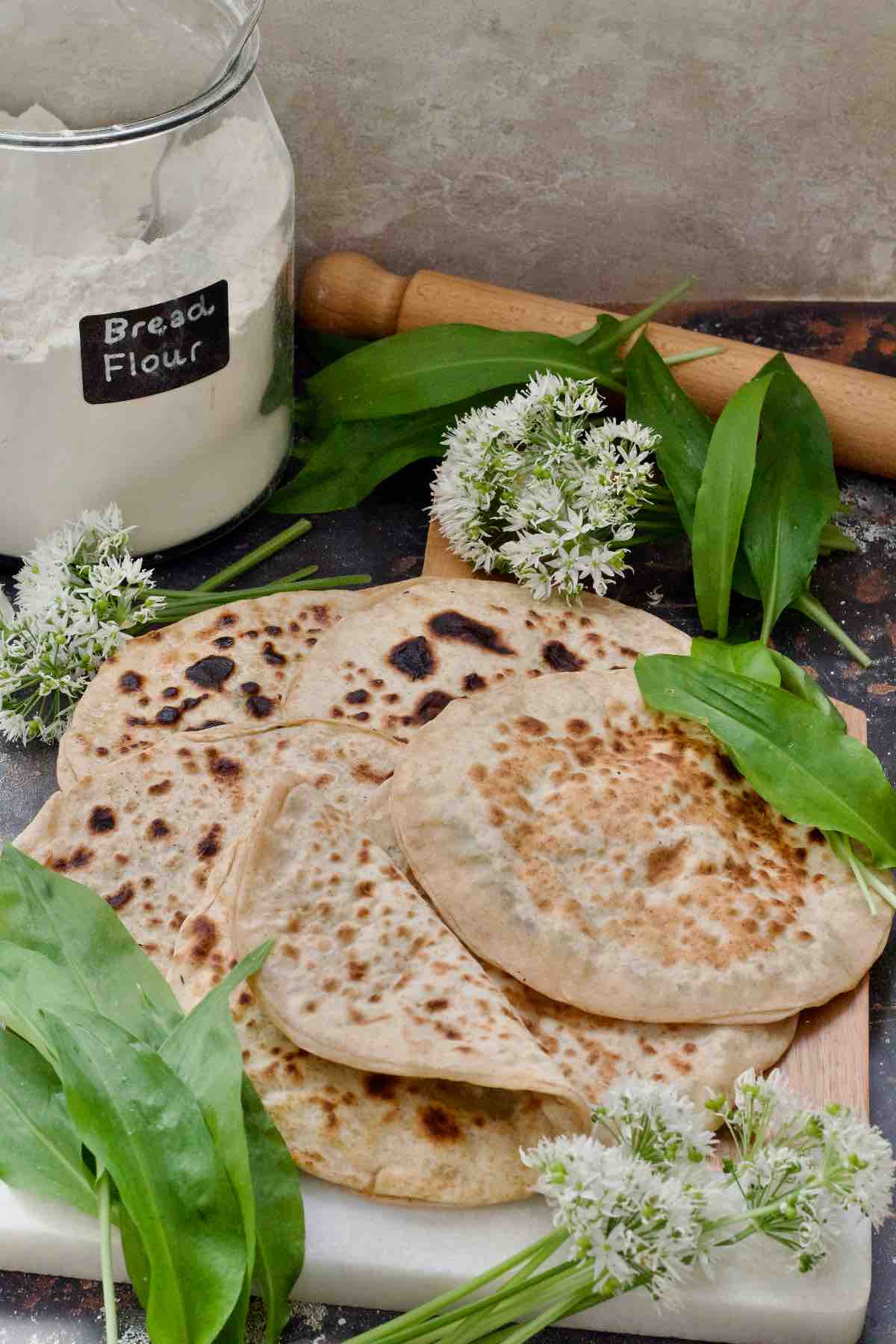
🍳 How to make Aloo Paratha
Ingredient quantities & detailed instructions to be found in recipe card at the bottom of the post.
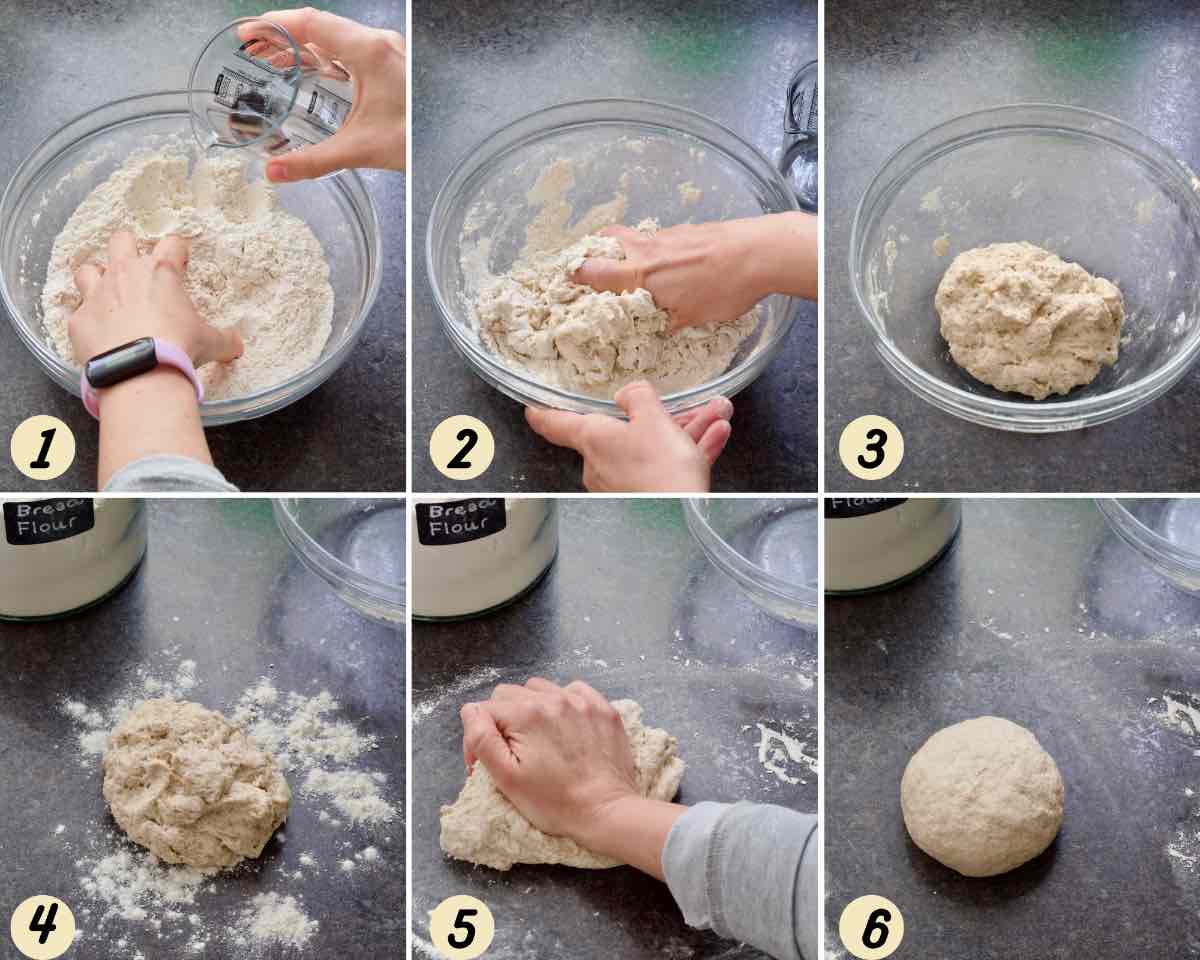
Start by making paratha dough.
In a large bowl mix together flour(s) and salt.
Slowly, bit by bit start adding water and incorporating it into the flour to form a dough. You want the dough to come together with all the flour incorporated without being too sticky or too dry.
***Quick Tip*** The amount of water needed will depend on the flour(s) you're using. Wholemeal flours tend to be "thirstier" when it comes to water. I used 50/50 white and chapati (atta) flours which used up about 150ml water (you might need less or a bit more). Remember to go slow and add more water as you go.
Once you got a rough dough ball together, tip it out onto lightly floured counter and knead for a few minutes until your dough feels smooth and elastic. The dough had enough kneading when it springs back when gently poked with a finger.
Pop the dough back into lightly oiled bowl, cover and let it rest for about 30 minutes. to rest as you prepare the filling.
***Quick Tip*** Resting part is quite important as even though the dough won't rise, the gluten in the flour will relax and make rolling out the dough much easier.
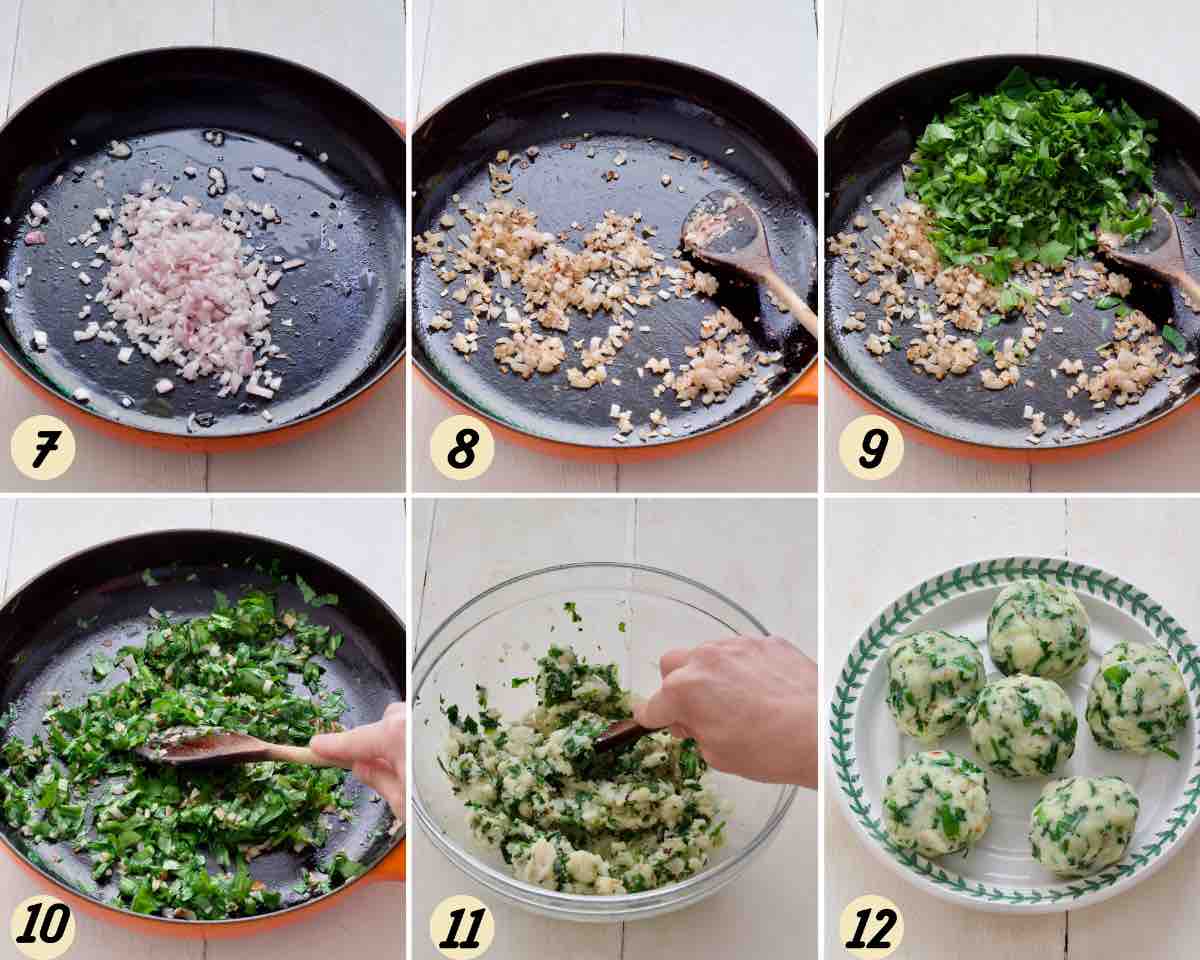
As your dough rests prepare the filling.
Heat up tablespoon or two of oil/olive oil in a pan and sauté finely chopped shallots or onions until they start to soften and become translucent (approx. 5 minutes).
Next, add chopped wild garlic and mix it in and allow it to wilt slightly (1 min).
In a large bowl mix together cold mashed potato with shallot/wild garlic mixture. Season with salt and pepper to taste.
Divide the mixture into 6 equal size balls and set aside (you can even put it in the fridge) until needed.
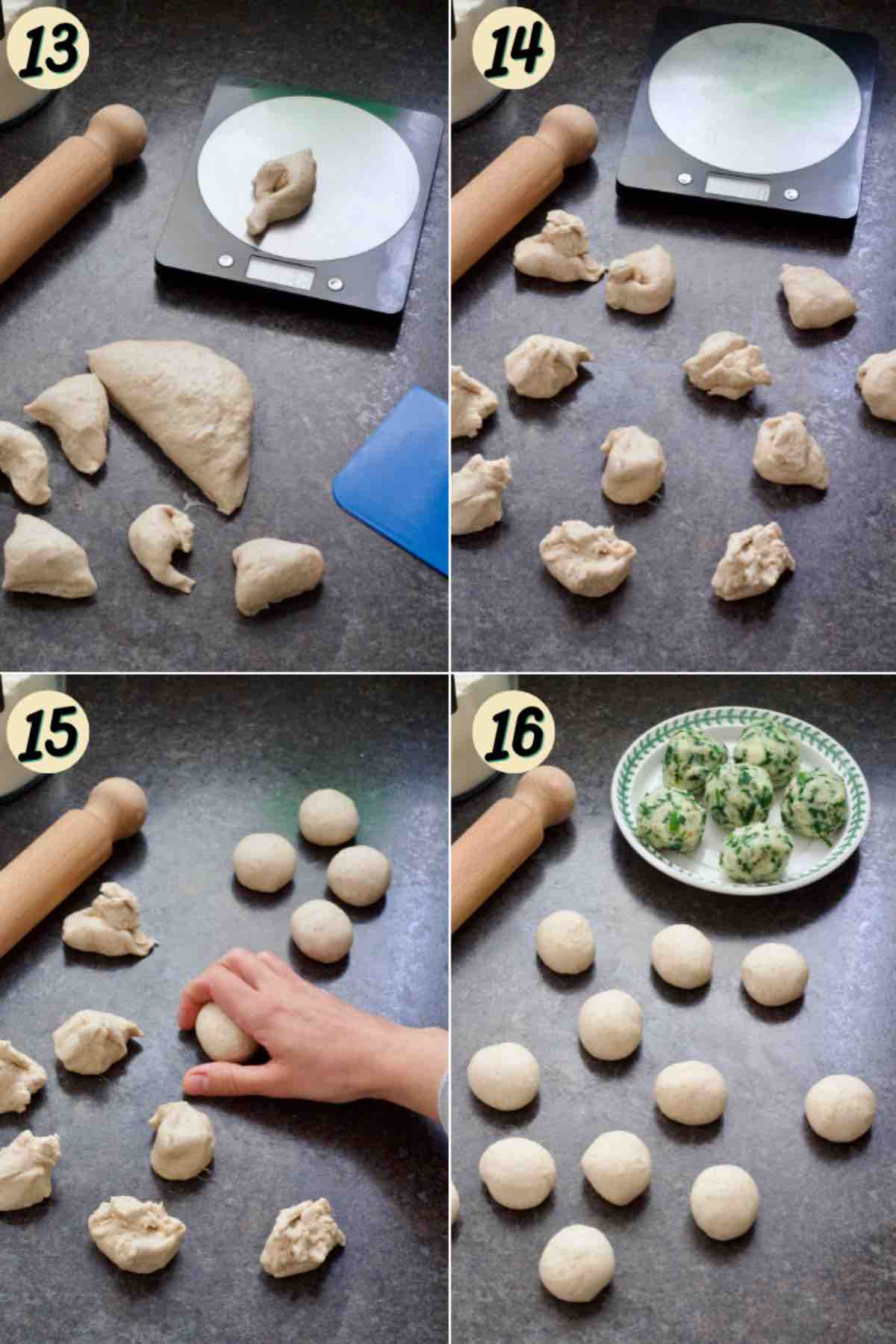
Once your dough had its rest divide it into 12 equal pieces (I like to be precise here and weigh my dough on the kitchen scales).
Cup each dough ball with your hand and gently roll around until nice, smooth and uniform looking.
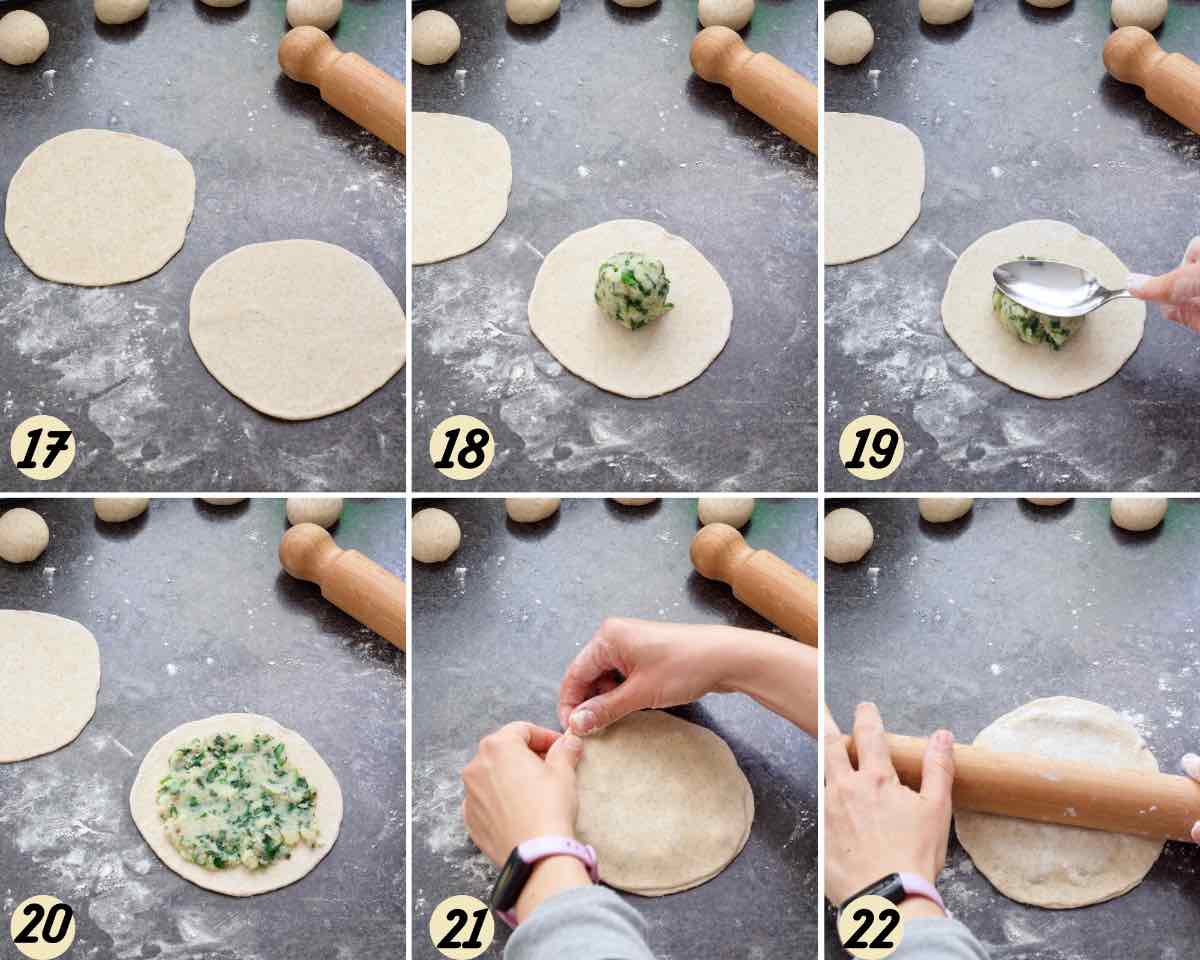
You will need two rolled out balls of dough and one ball of filling per paratha.
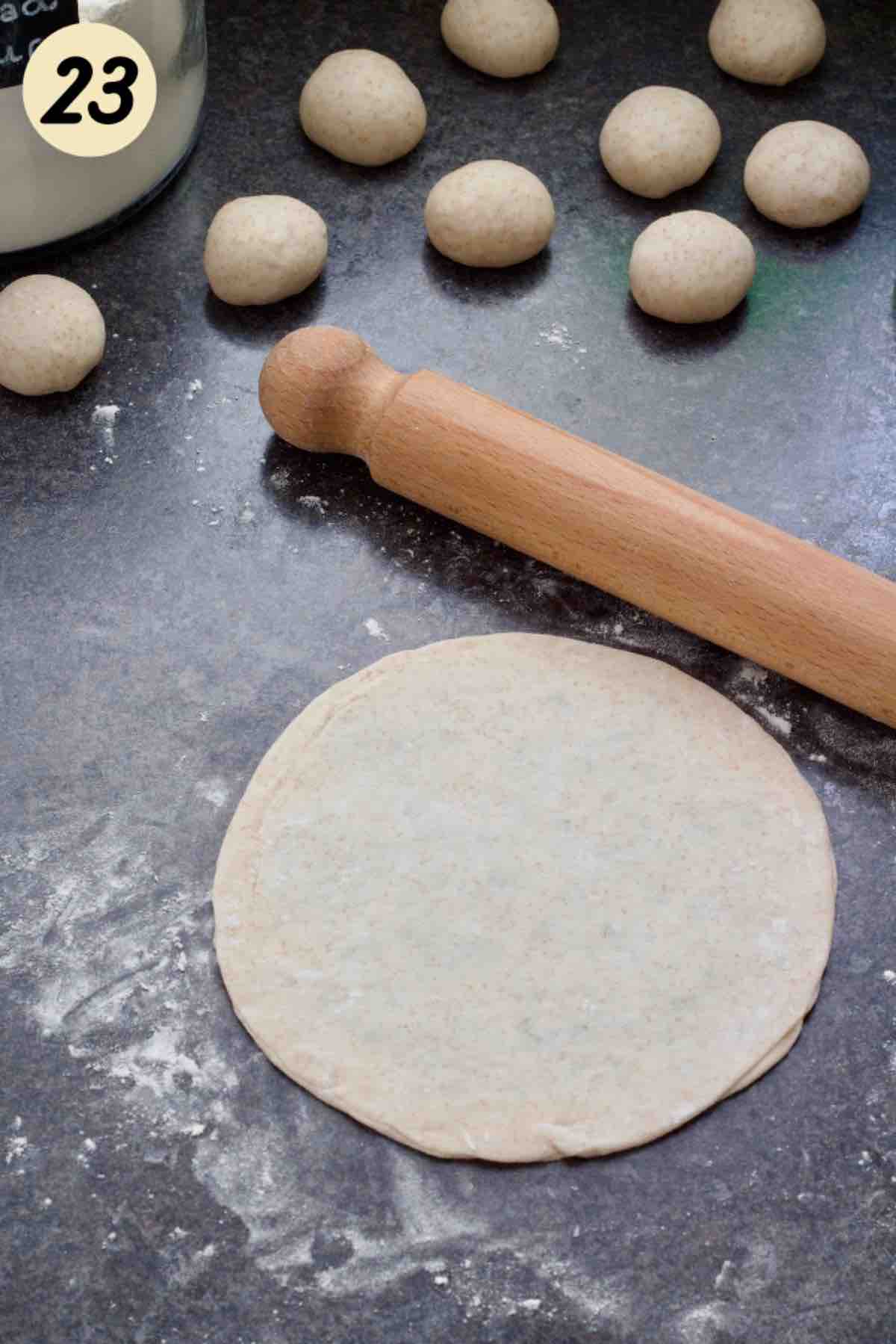
Dust the kitchen counter and rolling pin generously with flour and roll 2 dough balls out into two discs roughly 14cm/5.5in in diameter.
Put filling ball in the middle of one of your rolled out discs and flatten it with a spoon so that it covers most of the disc leaving approx. 2cm/0.8in border.
Put second disc on top and then pinch the edges together to seal the paratha.
Sprinkle over a little more flour and roll the paratha out again to flatten it a little more. My parathas are roughly 19cm/7.5in in diameter.
Repeat with remaining dough and filling.
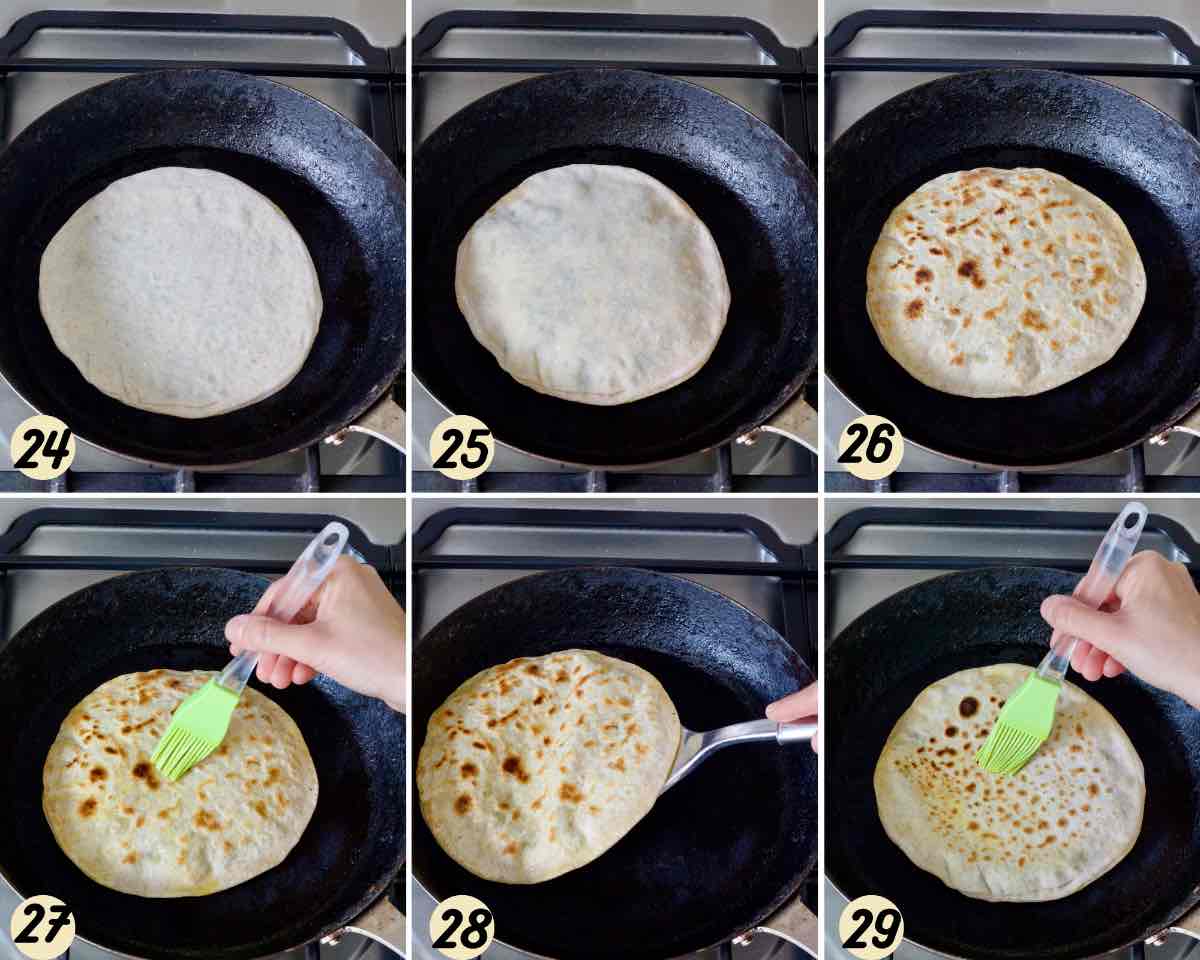
To cook aloo parathas heat up the non-stick pan or skillet over medium heat and once hot gently add one paratha at a time.
***Quick Tip*** You want to dry cook your parathas and only oil each side once flipped.
Let it cook until your paratha starts to very gently puff up (see pic25). Take a look underneath and if you see nice brown coloured spots, it's time to flip. First side might take anything from 30 seconds to almost 2 minutes.
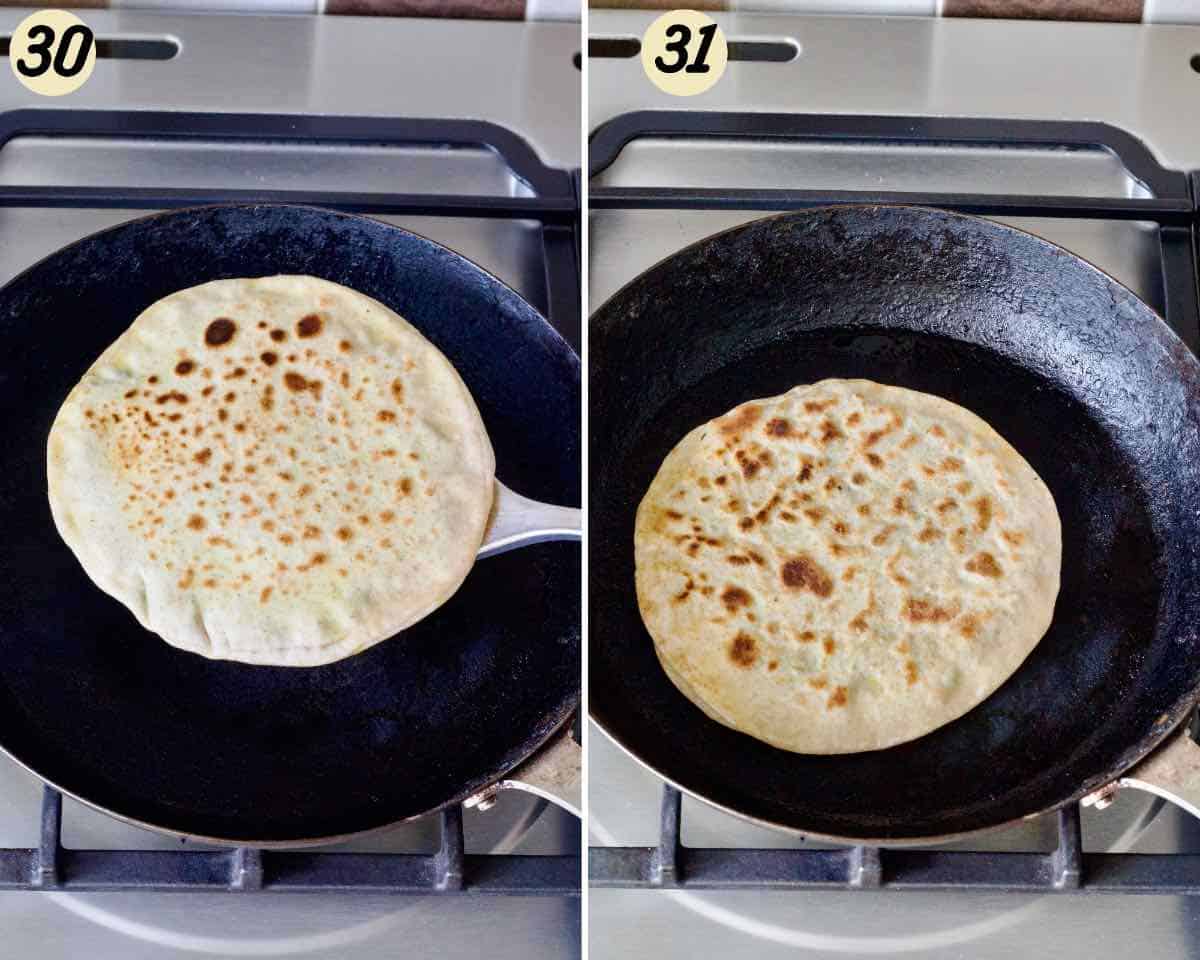
As second side is browning it's time to oil/butter the first side that has just been cooked. Then again, take a look underneath to check whether the other side has coloured and flip again oiling the second side.
After 30 seconds give it one last flip, cook for another 30 seconds and transfer paratha onto a plate.
Repeat with remaining parathas until done.
🍽 Equipment
Even though there isn't really any special equipment required to make parathas you will need a rolling pin (or you could use a bottle) and a good non-stick pan.
I shared some thoughts regarding my go to heavy-duty skillet here (scroll down to equipment section) if you'd like to take a look.
🥡 Storing and Freezing Wild Garlic and Potato Paratha
Store: As with many things aloo parathas are simply the best eaten fresh once they're made. However, they can be stored in the fridge in the airtight container or reusable silicone bags for up to 3 days.
Reheat: As cold paratha isn't particularly nice (in my opinion anyway) you will need to reheat it first. For softer (soggier) paratha all you need is 30 sec in a microwave. Be careful as filling can get really hot.
For a crispier alternative, reheat it in a dry pan/skillet until warmed through, oiling/buttering lightly on both sides as you did when you cooked them.
Freeze: You can freeze parathas for a standard up to 3 months. Make sure to separate them with some freezer friendly baking/parchment paper to prevent them from sticking.
If you're making more with the intention to freeze I would recommend cooking them ever so lightly (just slightly undercooking) and skipping oil/butter brushing part. You will then finish cooking them fully (including oiling bit) straight out of the freezer (no need to defrost).
However, if you found yourself with fully cooked leftovers, these can still be frozen and should be reheated in a pan straight from the freezer to prevent them from going soggy on the counter. They will still be good might be just a bit more coloured.
💭 Pro tips
Read my advice regarding flour above for best results.
Use warm water as suggested which will help the dough to "relax" quicker.
Don't add all the water at once. The amount of water needed will depend on types of flour(s) used.
Let the dough rest for 30 minutes or you might struggle with rolling it out.
Don't use too much flour on the surface when rolling out the dough as it might make tough parathas. Dust off any excess before cooking.
Make sure the pan is nice and hot before cooking. Keep an eye on temperature and try to keep it nice and even to prevent parathas from burning.
Keep your freshly made parathas in a low oven as you cook to keep them warm. Alternatively, keep them stacked on a plate and covered with a clean tea towel to keep them warm and moist.
Make sure your leftover mash is not too creamy, it should be quite stiff when cold or there will be too much moisture in the filling. You need it to be quite firm.
Don't overstuff paratha with filling. I know it's tempting but you don't want for it to all ooze out during cooking.
🍴 Serving suggestions
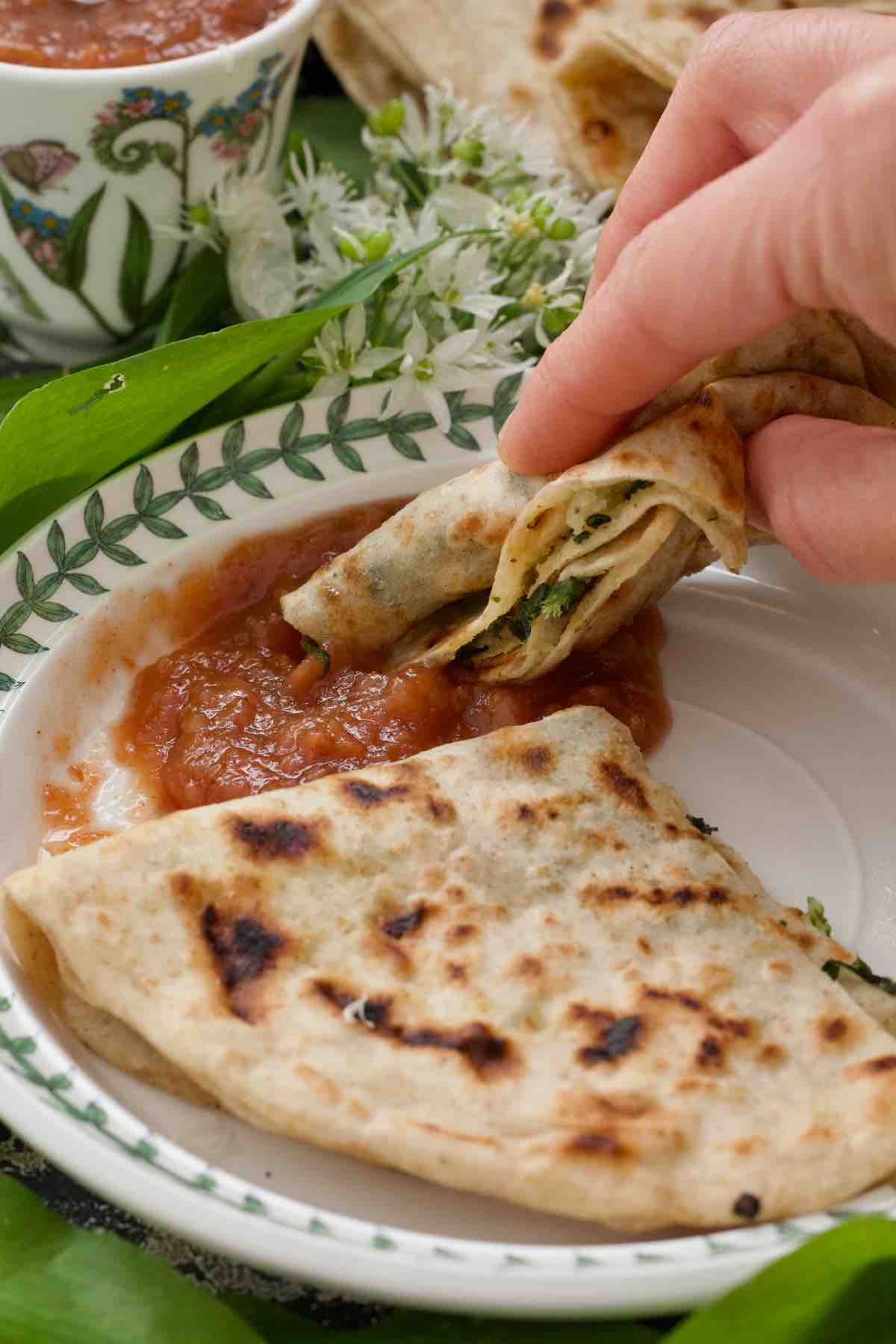
Aloo parathas make great side to any curry, stew or soup. We love it with my tarka dhal with spinach.
However, as they're quite substantial and filling they can also be enjoyed on their own with your favourite pickle, chutney, yogurt or yogurt based dip like tzatziki, cucumber raita and (even though not very authentic) my easy tartare sauce.
❓ FAQ
These are some of my favourite substitutes:
- green onions with finely chopped clove or two of regular garlic
- sautéed leeks (green parts controversially) + regular garlic as above
- roasted head of garlic squeezed out into the mash (the amount will depend on your taste, you might not want entire head even though it's not harsh but lovely and mellow and sweet).
- greens of choice (spinach, kale, spring greens) + regular garlic as above; some greens might need more cooking in the pan with the onion than others.
Have you tried my Wild Garlic and Potato Paratha?
Please consider giving it ⭐️⭐️⭐️⭐️⭐️ rating in recipe card below and share your views or tips in the comments.
😋 More wild garlic recipes
Vegan Cheese Scones (with wild garlic)
Cheese and Onion Quiche (with wild garlic)
Wild Garlic Pesto Baked Salmon with Gnocchi
📋 Recipe
Wild Garlic and Potato Paratha (Aloo Paratha)
Ingredients
- 125 g strong white bread flour plain/all-purpose flour can be used too
- 125 g chapati (atta) flour or regular wholemeal flour
- ½ teaspoon fine salt
- 150 ml warm water see notes
- cold-pressed rapeseed oil or light olive oil to brush on parathas you can use melted butter or ghee or plant butter instead
Filling
- 200 g cold leftover mashed potato see notes
- 50 g shallot or onion (small) finely chopped
- 50 g wild garlic washed and roughly chopped, see notes
- 2 tablespoon olive oil for sautéing
- salt and pepper to taste
Instructions
- Start by making paratha dough. In a large bowl mix together flour(s) and salt.Slowly, bit by bit start adding water and incorporating it into the flour to form a dough. You want the dough to come together with all the flour incorporated without being too sticky or too dry.***Quick Tip*** The amount of water needed will depend on the flour(s) you're using. Wholemeal flours tend to absorb more water. I used 50/50 white and chapati (atta) flours which used up about 150ml water (you might need less or a bit more). Remember to go slow and add more water as you go.Once you got a rough dough ball together, tip it out onto lightly floured counter and knead for a few minutes until your dough feels smooth and elastic. The dough had enough kneading when it springs back when gently poked with a finger. Pop the dough back into lightly oiled bowl, cover and let it rest for about 30 minutes. to rest as you prepare the filling.***Quick Tip*** Resting part is quite important as even though the dough won't rise, the gluten in the flour will relax and make rolling out the dough much easier.125 g strong white bread flour, 125 g chapati (atta) flour, ½ tsp fine salt, 150 ml warm water
- As your dough rests prepare the filling. Heat up tablespoon or two of oil/olive oil in a pan and sauté finely chopped shallots or onions until they start to soften and become translucent (approx. 5 minutes).Next, add chopped wild garlic and mix it in and allow it to wilt slightly (1 min). In a large bowl mix together cold mashed potato with shallot/wild garlic mixture. Season with salt and pepper to taste. Divide the mixture into 6 equal size balls and set aside (you can even put it in the fridge) until needed.200 g cold leftover mashed potato, 50 g shallot or onion (small), 50 g wild garlic , 2 tbsp olive oil for sautéing , salt and pepper to taste
- Once your dough had its rest divide it into 12 equal pieces (I like to be precise here and weigh my dough on the kitchen scales). Cup each dough ball with your hand and gently roll around until nice, smooth and uniform looking.
- You will need two rolled out balls of dough and one ball of filling per paratha. Dust the kitchen counter and rolling pin generously with flour and roll 2 dough balls out into two discs roughly 14cm/5.5in in diameter. Put filling ball in the middle of one of your rolled out discs and flatten it with a spoon so that it covers most of the disc leaving approx. 2cm/0.8in border. Put second disc on top and then pinch the edges together to seal the paratha.Sprinkle over a little more flour and roll the paratha out again to flatten it a little more. My parathas are roughly 19cm/7.5in in diameter. Repeat with remaining dough and filling.
- To cook aloo parathas heat up the non-stick pan or skillet over medium heat and once hot gently add one paratha at a time. ***Quick Tip*** You want to dry cook your parathas and only oil each side once flipped.Let it cook until your paratha starts to very gently puff up (see pic25). Take a look underneath and if you see nice brown coloured spots, it's time to flip. First side might take anything from 30 seconds to almost 2 minutes.As second side is browning it's time to oil/butter the first side that has just been cooked. Then again, take a look underneath to check whether the other side has coloured and flip again oiling the second side. After 30 seconds give it one last flip, cook for another 30 seconds and transfer paratha onto a plate. Repeat with remaining parathas until done.Enjoy!cold-pressed rapeseed oil or light olive oil to brush on parathas
Notes
- Nutritional information is per paratha (based on 6 parathas) is approximate and should be treated as a rough guideline only. It doesn't not include oil/butter used to brush on parathas while cooking.
Comments
No Comments