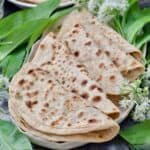
Wild Garlic and Potato Paratha (Aloo Paratha)
Wild garlic and potato paratha (aloo paratha) is my take on an Indian potato stuffed flatbread. I stuff mine very simply with a mixture of wild garlic, shallots and mashed potato. It's a flexible recipe that is easy to adapt as seasons change so it can be enjoyed all year round. So delicious!
Servings 6 servings
Calories 236kcal
Ingredients
- 125 g strong white bread flour plain/all-purpose flour can be used too
- 125 g chapati (atta) flour or regular wholemeal flour
- ½ teaspoon fine salt
- 150 ml warm water see notes
- cold-pressed rapeseed oil or light olive oil to brush on parathas you can use melted butter or ghee or plant butter instead
Filling
- 200 g cold leftover mashed potato see notes
- 50 g shallot or onion (small) finely chopped
- 50 g wild garlic washed and roughly chopped, see notes
- 2 tablespoon olive oil for sautéing
- salt and pepper to taste
Instructions
- Start by making paratha dough. In a large bowl mix together flour(s) and salt.Slowly, bit by bit start adding water and incorporating it into the flour to form a dough. You want the dough to come together with all the flour incorporated without being too sticky or too dry.***Quick Tip*** The amount of water needed will depend on the flour(s) you're using. Wholemeal flours tend to absorb more water. I used 50/50 white and chapati (atta) flours which used up about 150ml water (you might need less or a bit more). Remember to go slow and add more water as you go.Once you got a rough dough ball together, tip it out onto lightly floured counter and knead for a few minutes until your dough feels smooth and elastic. The dough had enough kneading when it springs back when gently poked with a finger. Pop the dough back into lightly oiled bowl, cover and let it rest for about 30 minutes. to rest as you prepare the filling.***Quick Tip*** Resting part is quite important as even though the dough won't rise, the gluten in the flour will relax and make rolling out the dough much easier.125 g strong white bread flour, 125 g chapati (atta) flour, ½ tsp fine salt, 150 ml warm water
- As your dough rests prepare the filling. Heat up tablespoon or two of oil/olive oil in a pan and sauté finely chopped shallots or onions until they start to soften and become translucent (approx. 5 minutes).Next, add chopped wild garlic and mix it in and allow it to wilt slightly (1 min). In a large bowl mix together cold mashed potato with shallot/wild garlic mixture. Season with salt and pepper to taste. Divide the mixture into 6 equal size balls and set aside (you can even put it in the fridge) until needed.200 g cold leftover mashed potato, 50 g shallot or onion (small), 50 g wild garlic , 2 tbsp olive oil for sautéing , salt and pepper to taste
- Once your dough had its rest divide it into 12 equal pieces (I like to be precise here and weigh my dough on the kitchen scales). Cup each dough ball with your hand and gently roll around until nice, smooth and uniform looking.
- You will need two rolled out balls of dough and one ball of filling per paratha. Dust the kitchen counter and rolling pin generously with flour and roll 2 dough balls out into two discs roughly 14cm/5.5in in diameter. Put filling ball in the middle of one of your rolled out discs and flatten it with a spoon so that it covers most of the disc leaving approx. 2cm/0.8in border. Put second disc on top and then pinch the edges together to seal the paratha.Sprinkle over a little more flour and roll the paratha out again to flatten it a little more. My parathas are roughly 19cm/7.5in in diameter. Repeat with remaining dough and filling.
- To cook aloo parathas heat up the non-stick pan or skillet over medium heat and once hot gently add one paratha at a time. ***Quick Tip*** You want to dry cook your parathas and only oil each side once flipped.Let it cook until your paratha starts to very gently puff up (see pic25). Take a look underneath and if you see nice brown coloured spots, it's time to flip. First side might take anything from 30 seconds to almost 2 minutes.As second side is browning it's time to oil/butter the first side that has just been cooked. Then again, take a look underneath to check whether the other side has coloured and flip again oiling the second side. After 30 seconds give it one last flip, cook for another 30 seconds and transfer paratha onto a plate. Repeat with remaining parathas until done.Enjoy!cold-pressed rapeseed oil or light olive oil to brush on parathas
Notes
- Nutritional information is per paratha (based on 6 parathas) is approximate and should be treated as a rough guideline only. It doesn't not include oil/butter used to brush on parathas while cooking.
The amount of water used will depend on your flour(s). Add it gradually and as needed to achieve dough that is neither sticky nor dry.
If you don't have leftover mash simply cook and mash some potatoes. Don't make them creamy and allow them to cool down.
You might want to start with less wild garlic first, taste and increase the amount as needed.
Leftover parathas can be kept in the fridge for up to 3 days or frozen for up to 3 months. For more information on that see 🥡 Storing and Freezing Wild Garlic and Potato Paratha.
Nutrition
Calories: 236kcal | Carbohydrates: 41g | Protein: 7g | Fat: 6g | Saturated Fat: 1g | Polyunsaturated Fat: 1g | Monounsaturated Fat: 3g | Sodium: 201mg | Potassium: 265mg | Fiber: 4g | Sugar: 1g | Vitamin A: 3IU | Vitamin C: 11mg | Calcium: 39mg | Iron: 2mg